High strength shackle
Last updated: September 2026
At Baumgart, you can order shackles in 15 load capacity levels from 0.33 t to 25 t directly from stock in Ochtrup: as straight D shackles or curved bow shackles, with either a screw pin or a bolt with nut and split pin. All high-strength shackles are hot-dip galvanised and marked with a stamped load capacity. Larger versions of up to 55 t are available on request.
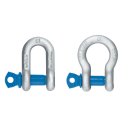
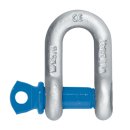
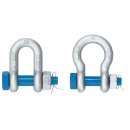
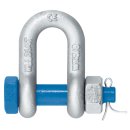
Buy shackles for cranes, lifting technology and heavy loads
A shackle is the connecting link between slinging equipment and the load attachment point. The U-shaped bow is passed over the lifting point and closed with a pin. This creates a detachable, positive-locking connection that transmits high tensile forces. Typical combinations are roundslings on the crane hook, chain slings on load eyes or webbing slings on attachment points.
When buying shackles, pay attention to four points: load capacity (WLL), bow shape, pin locking and material. The choice depends on the load weight, the sling angle, the number of sling legs and the operating environment. Our lifting shackles with a hot-dip galvanised bow, painted pin and stamped load capacity cover the spectrum from light workshop tasks to heavy-duty applications in crane construction.
What types of shackles are there?
In terms of bow shape, a distinction is made between straight D shackles and curved bow shackles. For pin locking, the screw pin and the combination of bolt, nut and split pin are the two common variants. In the hoist sector, both designs are also referred to as load shackles or lifting shackles.
D shackle: straight shape
The straight shackle – also called a D shackle – has a narrow, U-shaped bow and is used when the load pulls in a straight line. The compact design saves space and guides the sling directly. For multi-leg slinging with different pulling angles, the curved bow shape is the better choice.
Bow shackle: curved shape
The curved shackle – commonly called a bow shackle – has a wide, rounded interior. This shape is the right choice when several slings are attached to one shackle – for example with two-leg or four-leg slings, roundslings with a large cross-section or movable connections with changing sling angles. The larger interior reduces bending stress on the sling and prevents jamming under load.
Shackles with screw pin
The screw pin is screwed into the thread of the bow and is held firmly by the conical contact surface. Shackles with a screw pin can be opened and closed by hand and are suitable for connections that are released regularly – for example when shackles are moved between different loads at shift changes or for short lifting operations.
Shackles with nut and split pin
Shackles with eye bolt, nut and split pin additionally secure the pin against turning. This combination is used when the connection is under load for a longer period, when vibrations occur or when frequent load changes are expected – typically when slinging precast concrete elements over several days, for fixed assembly connections or in heavy-load transport. The split pin prevents the nut from loosening by itself and makes the connection lower-maintenance. Opening takes a little more time than with a screw pin, but you gain noticeably in operational safety.
Shackle sizes and shackle load capacities at a glance
We stock shackles in 15 load capacity levels. The following shackle load capacity table shows which sizes are available with a screw pin or with nut and split pin. Detailed shackle dimensions – pin diameter, jaw width and inside width – can be found on the respective product page.
Load capacity (WLL) |
With screw pin |
With nut and split pin |
0.33 t |
✓ |
– |
0.5 t |
✓ |
✓ |
0.75 t |
✓ |
✓ |
1.0 t |
✓ |
✓ |
1.5 t |
✓ |
✓ |
2.0 t |
✓ |
✓ |
3.25 t |
✓ |
✓ |
4.75 t |
✓ |
✓ |
6.5 t |
✓ |
✓ |
8.5 t |
✓ |
✓ |
9.5 t |
✓ |
✓ |
12.0 t |
✓ |
✓ |
13.5 t |
✓ |
✓ |
17.0 t |
✓ |
✓ |
25.0 t |
✓ |
✓ |
25.0 – 55.0 t |
on request |
on request |
When selecting the right level, take the following into account:
Load weight: relative to the individual attachment point, not to the total weight of the load.
Sling angle: with multi-leg slinging, the permissible load per leg decreases as the angle to the vertical increases.
Load case: static, dynamic or with shock loading. Swinging loads or jerky lifting generate higher loads than the pure weight force.
Jaw width and pin diameter: must match the thickness of the sling and the shape of the lifting eye.
When used in combination with roundslings or webbing slings, choose the shackle size so that the textile sling remains free to move in the curved interior and does not bend over the pin or the edges of the bow.
Enquire about suitable shackles now
Galvanised or stainless steel shackles: the question of material
For lifting and slinging technology in industry, workshops, construction and logistics, hot-dip galvanised shackles are the standard. The zinc layer reliably protects the forged steel against corrosion and is sufficient for many years indoors, in covered outdoor areas and in moderate weather conditions.
Stainless steel shackles are a special design for permanently corrosive environments – typically contact with salt water in the marine and offshore sector (also known as anchor shackles) or applications in chemically aggressive atmospheres. Stainless steel shackles often have lower load capacities than versions made of quenched and tempered steel and are sometimes covered by separate standard specifications such as DIN 82101. We do not stock stainless steel shackles in our standard range. If your application requires permanent corrosion resistance, we will advise you on a suitable alternative or clarify the order with the manufacturer.
Typical applications for lifting shackles and load shackles
Shackles are used wherever detachable and resilient connections are needed in lifting technology. In mechanical engineering and workshops, they serve as the link between the chain sling and the lifting point on the machine, for example when relocating machine tools or large components. In steel and plant construction, load shackles connect webbing slings or roundslings to beams, containers or welded structures. On the construction site, they are used to sling precast concrete elements, formwork elements and steel components. In warehouse and transport logistics, shackles are the connecting element between the sling and the load during crane and forklift work – suitably combined with load handling attachments and crane accessories.
In particularly safety-critical or long-term applications, shackles with nut and split pin are used. For temporary lifting operations with frequent load changes, screw pin versions are the more ergonomic choice.
Visual inspection, maintenance and safe use
Shackles are part of slinging equipment accessories. In Germany, they are subject to the inspection obligations of the Industrial Safety Regulation (BetrSichV) and DGUV Rule 100-500; in other countries, the respective national regulations apply. In practice, this means:
Visual inspection before each use by the user. A deformed bow, compressed pin, damaged thread, missing or broken split pin, corrosion pitting or load capacity marking that has become illegible lead to immediate withdrawal from use.
Annual inspection by a competent person, with documentation. Shorter intervals are necessary in the case of intensive use.
Close the pin completely. Screw the screw pin in as far as it will go and secure the nut and split pin correctly. Loose or only partially screwed-in pins are a common cause of accidents.
Observe the direction of loading. Shackles are designed for tension along the axis of the bow – side loading on the pin significantly reduces the permissible load capacity.
On request, we can carry out the annual inspection of your slinging equipment and accessories by a competent person directly – find out more on our inspection service page.
Order shackles online from Baumgart heben und sichern
Baumgart heben und sichern has been based in Ochtrup in the western Münsterland region of Germany since 1999 and supplies industry, trades, construction and logistics with lifting, slinging and securing technology. You can order shackles online directly in the shop – stock items are available at short notice and, for orders received by 12 noon (German time), are dispatched from our warehouse in Ochtrup on the same working day. We clarify special versions above 25 t and custom designs by telephone or e-mail.
You can reach us on +49 (0)2553 5312 or by e-mail at mail@heben-sichern.de. Address: Baumgart heben und sichern GmbH, Von-Gallitzin-Str. 4, 48607 Ochtrup, Germany.
Frequently asked questions about shackles
WLL stands for “Working Load Limit” and indicates the maximum working load in tonnes with which a shackle may be loaded in normal operation. The WLL is stamped on the bow. For high-strength shackles, the calculated breaking load is six times the WLL (safety factor 6).
The D shackle has a straight, narrow bow and is suitable for loads in one direction of pull. The bow shackle is curved, offers more interior space and is the right choice for multi-leg slinging or wide roundslings. The load capacity classes are identical for both designs.
Choose the next load capacity level above the load weight per attachment point. A safety margin is advisable if shock loads, swinging movements or inclined pulling angles occur. The bow shape (D shackle or bow shackle) depends on the number and angle of the sling legs, and the pin locking depends on the duration of use and vibrations.
The load capacity (WLL) is stamped directly into the bow, together with the manufacturer’s code and batch marking. If these markings are illegible, corroded or ground off, the shackle must no longer be used.
No. High-strength shackles are designed for tension in the longitudinal direction of the bow. Transverse loading of the pin, for example due to side pull from a chain sling, significantly reduces the permissible load capacity and can lead to component failure. In such cases, shackles approved for transverse loading or an upstream swivel are used.
The pin is screwed into the thread by hand until it reaches a firm stop. Tightening with a torque wrench is not necessary – the conical seat of the pin shoulder ensures the positive-locking connection. It is important that the pin is fully seated and cannot loosen by itself under load.
Yes. It is important that the interior of the shackle is large enough for the sling to remain free to move and not be bent over the pin or the edge of the bow. For wide roundslings or webbing slings, choose a bow shackle with a suitable jaw width.
Yes. Shackles that have demonstrably been overloaded must be withdrawn from use immediately, even if they show no external damage. Internal structural changes cannot be ruled out without a factory inspection. Repairing shackles is not permitted – the component must be replaced.
Yes. Shackles of up to 25 t are available directly from stock. We order load capacities between 25 t and 55 t from the manufacturer on request. Simply send us a short description of the application, including the load weight and the required bow shape – we will let you know the price and delivery time.