Demag: cranes, hoists, KBK and spare parts from an official partner
Last updated: September 2026
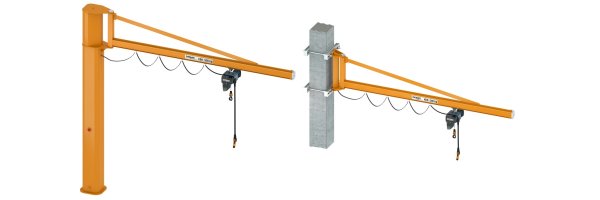
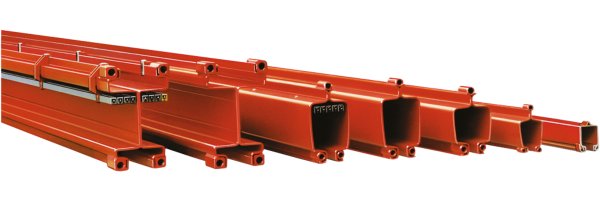
Are you looking for the right Demag spare part, a control pendant or components for your KBK crane runway? Baumgart heben und sichern from Ochtrup, Germany, is an official Demag partner. As a sales partner and dealer, we supply industry, trade and logistics with original components, hoists, KBK profiles and complete crane systems. We carry the entire Demag range with more than 10,000 original Demag components – from brake sets and load chains for chain and rope hoists to DSC, DSK and DST control pendants, DCL conductor rails, pillar and wall-mounted jib cranes and complete KBK profile systems.







The Demag product portfolio at a glance
Demag covers three major product areas: hoists, cranes and components. Hoists include chain hoists, rope hoists and heavy-duty hoist units. Cranes range from pillar jib cranes and suspension cranes to overhead travelling cranes for process applications. Components form the third pillar, including the modular KBK light crane system, the DCL compact conductor line, control pendants, contactors, travel drives and frequency inverters.
Demag chain hoists: DC-Com, DC-Pro and older generations
Demag has been building electric chain hoists for decades in three successive main generations. If you are looking for a spare part, you first need to identify the series. Load chains, brakes and chain guides are usually not interchangeable between generations.
The DC-Com is the standard solution for medium-duty applications. It comes in four sizes (Com 1, 2, 5, 10) with load capacities from 80 to 2,000 kg. 24 V contactor control, two lifting speeds, an operating hours counter and a diagnostic interface are integrated as standard. The FEM classification ranges from 1Am/M4 to 2m/M5, depending on size and reeving. Typical applications are workshops, storage areas and light assembly work.
The DC-Pro covers the more demanding segment. Six sizes (Pro 1, 2, 5, 10, 16, 25) with load capacities from 80 to 5,000 kg are available. The standard classification is 2m+ with 1,900 full-load hours, around 20 per cent above the classic 2m class. For more intensive operation, classes 3m/M6 and 4m/M7 are available.
For sizes DC 1 to 10, the gearbox, slipping clutch and brake are maintenance-free for up to ten years. A speed-monitored slipping clutch protects against overload without the load being able to drop. The safety-related functions meet at least Performance Level c and Category 2 according to EN ISO 13849-1.
Feature |
DC-Com |
DC-Pro |
Load capacity |
80 to 2,000 kg |
80 to 5,000 kg |
Sizes |
4 (Com 1, 2, 5, 10) |
6 (Pro 1, 2, 5, 10, 16, 25) |
FEM and ISO class |
1Am/M4 to 2m/M5 |
1Am/M4 to 4m/M7 |
Standard classification |
1Am to 2m |
2m+ (1,900 h full load) |
Maintenance-free brake |
Standard interval |
Up to 10 years (DC 1 to 10) |
Infinitely variable lifting speed |
Optional |
Optional via frequency inverter |
Typical use |
Workshop, warehouse |
Industry, continuous operation |
For integration into customer-side control systems, Demag offers the DC-Pro with direct control. It is available in seven sizes with load capacities from 80 to 5,000 kg and is operated via a switched mains supply. Typical applications include lifting gates and furnace lids at high ambient temperatures.
PK and DK are the predecessor generations of the DC family. Neither is manufactured new any more, but the supply of spare parts is ensured. Load chains, chain guides and brake sets differ significantly from the DC series. When ordering, always take the series and size directly from the rating plate.
Demag rope hoists and heavy-duty hoist units
In the rope hoist segment, Demag has introduced several main series over the decades. The order matters when you want to order a wear part. We support systems of all generations with spare parts.
The P rope hoist is the historic Demag series and today only concerns the spare parts business.
The DH series is the heavy-duty standard hoist unit in the Demag range. Four sizes (DH 400, 600, 1000 and 2000) cover load capacities from one tonne up to 100 tonnes. Hook paths exceed 100 metres. Standard designs are foot-mounted hoist, monorail trolley (also for curved tracks), short-headroom trolley and double-rail trolley.
The technical feature of the DH series is the conical-rotor motor (also called cone-rotor motor in older literature). When switched on, the magnetic field pulls the conically shaped rotor axially into the stator and releases the brake at the same time. When switched off, a spring pulls the rotor back and closes the brake automatically. This design makes motor and brake a compact, low-wear unit.
A mechanical micro-speed unit with a speed ratio of 1:6 or 1:10 allows precise positioning even with heavy loads. DH hoist units work reliably in foundries, electroplating plants, rolling mills and architectural applications with demanding ambient conditions.
For years, the DR series was the compact standard solution. The DR-Pro covered the upper performance range and reached up to 50 tonnes as a double-rail trolley. With the TwinHoist DR-Pro 20, two rope hoists can be combined into one unit, reaching up to 100 tonnes. The DR-Com was the economical version with three sizes from 2 to 10 tonnes, while the DR-Bas was mainly used in emerging markets and the USA.
In 2015, Demag introduced the modular DMR rope hoist (Demag Modular Rope Hoist). It replaced DR-Pro, DR-Com and DR-Bas as a common technical platform. Five sizes cover load capacities up to 50 tonnes. The DMR is available as a foot-mounted hoist, monorail trolley, double-rail trolley and low-headroom monorail trolley. For the first time, a C or co-axial design was possible on one platform. The mechanism groups range from 1Bm/M3 to 4m/M7.
With the DVR rope hoist introduced in 2023, Demag has further developed the DMR platform. The F-DVR foot-mounted hoist reaches up to 80 tonnes, the EK-DVR monorail trolley up to 12.5 tonnes. Large drum diameters reduce hook drift. The SafeControl system is the most important electronic innovation. We continue to support existing systems with DMR components with spare parts.
Demag pillar and wall-mounted jib cranes
Pillar and wall-mounted jib cranes are the typical solution for stationary workstations. They allow precise lifting within a clearly defined working area and usually work together with an electric chain hoist from the DC family.
Demag pillar jib cranes stand freely on the floor and, depending on the design, cover slewing ranges of up to 360 degrees. They are suitable wherever you want to work independently of a wall or hall column.
Demag wall-mounted jib cranes are mounted on a wall or hall column and save floor space. Slewing ranges between 180 and 270 degrees are common. For tight workshop areas and assembly stations, they are often the most economical solution.
Demag KBK crane construction kit: the modular light crane system
For more than 60 years, the KBK crane construction kit has been the world's leading modular light crane system. Standardised profiles, connectors, trolleys and suspensions can be used to build suspension cranes, monorail systems, pillar jib cranes and wall-mounted jib cranes in almost any configuration.
The load capacity range extends from 80 kg to 3,200 kg. Single-girder cranes can be built for up to 2,000 kg. Uniform connection dimensions across all profile sizes make it easier to modify and extend existing systems.
KBK I is the smallest profile and is used for simple applications with low loads and short distances, for example at assembly workstations or in pre-assembly. The exact permissible load depends on the span and suspension distance.
The KBK II family is the workhorse of the system. KBK II is the standard profile, II-L a lighter version and II-H the reinforced design. They allow higher loads and larger spans.
KBK 25 is the current rail profile for power supply with trailing cables. Equipped with towing trolleys and cable trolleys, the carried flat cable reliably supplies your crane system with power.
KBK Aluline complements the light crane system with aluminium profiles. Aluminium profiles reduce the dead weight and make it easier to move hoists manually. The A12, A18 and A22 profiles can be combined with the classic KBK steel profiles. Since the latest extension, the suspension system for A22 carries up to 2,400 kg, which makes cranes with a load capacity of up to two tonnes possible.
Demag DCL conductor rail: the DCL-Pro compact conductor line
Cranes and monorail systems need a reliable power supply. The DCL conductor rail (Demag Compact Line) is Demag's answer to this. The current generation is the DCL-Pro with honeycomb technology in the housing profile and pre-assembled connection technology.
The DCL-Pro accommodates four to seven conductors and is available in sizes with copper cross-sections of 10, 15, 25, 38, 56 and 70 square millimetres. Currents of up to 200 amperes are possible in continuous operation. The permissible operating voltage ranges from 24 to 690 volts AC. Standard lengths of the straight sections are 4,000 millimetres. The degree of protection is IP 23, with sealing profile IP 24. Operating temperatures range from -30 °C to +70 °C. Current collector trolleys reach travel speeds of up to 200 metres per minute.
DCL-Pro is compatible with the older DCL generation and fits both KBK systems and classic overhead travelling cranes with the corresponding current collectors.
Demag control pendants: DSC, DSE, DSK, DST and DRC
Control pendants, also known as pendant control stations, are the direct interface between operator and hoist. Demag currently offers several pendant families designed for different control technologies and numbers of axes.
Pendant |
Hoist |
Axes or mounting positions |
Special feature |
DSC |
DC chain hoist |
2 axes |
Compact, one-hand operation |
DSE-10 |
DC chain hoist, DH hoist unit |
up to 3 axes |
TriState control |
DSE-10R |
DC chain hoist, DH hoist unit |
up to 3 axes |
CAN bus, display on the pendant |
DSK / DSK 3C-RJ |
DC chain hoist |
2 axes |
Mechanical interlock |
DST / DST 3C-RJ |
Cranes, hoists, machines |
3, 7 or 9 mounting positions |
Universal, can be coupled up to 18 |
DRC-6 / DRC-10 |
DC chain hoist, cranes |
variable |
Radio control with transmitter set |
The DSC is the compact two-axis pendant for simple lifting and lowering applications, often in combination with the DC-Com chain hoist. The DSE-10 covers up to three axes. With the CAN bus version DSE-10R, you can also show system-specific status data on the display.
The DSK complements the family with a mechanical interlock and is designed for more complex control tasks. The DSK 3C-RJ version offers additional operating functions for demanding operating environments.
The DST is the versatile standard pendant for contactor-controlled hoists and allows additional control elements to be fitted. With the DST 3C-RJ, an extended version is available for complex applications.
If you want to work wirelessly, choose the DRC radio controls. The range includes hand-held transmitters such as the DRC-10 and DRC-6 as well as matching receivers. A DRC-6 transmitter set for the DC family and the DRC-10 pouch holster are directly available in the shop.
In addition, we offer wear accessories for all pendant families, including rubber caps, covers, emergency stop buttons and control cables. When replacing a control pendant, compatibility with the existing control system is always decisive. If in doubt, we agree on the selection with you in advance on the basis of your rating plate.
Demag contactors and electrical components
Contactors switch the drives of hoists and travel units. In Demag systems, they are safety-relevant components that must match the control system and design exactly. The wrong contactor can lead to incorrect switching times, increased brake wear or, in the worst case, unsafe operating conditions.
We supply original Demag contactors as direct spare parts for crane and hoist controls. Additional electrical components such as DSM control units are also available.
FEM mechanism groups and duty cycle according to FEM 9.511 / ISO 4301
Demag classifies its hoists according to FEM 9.511. Internationally, this European standard corresponds to ISO 4301 with the classes M3 to M8. The mechanism group indicates the total service life and load spectrum a hoist is designed for. A higher class means a longer theoretical service life for the same design.
FEM group |
ISO class |
Full-load hours |
Typical application |
1Bm |
M3 |
400 h |
Very light duty, occasional use |
1Am |
M4 |
800 h |
Light duty, workshop, maintenance |
2m |
M5 |
1,600 h |
Medium duty, standard workshop operation |
2m+ |
M5+ |
1,900 h |
Standard DC-Pro, medium-heavy duty |
3m |
M6 |
3,200 h |
Heavy duty, multi-shift operation |
4m |
M7 |
6,300 h |
Very heavy continuous operation |
To choose the right FEM group, you need to know how often per hour lifting takes place, the average load and the lifting height. For intensive use with several lifting cycles per hour and high loads, you should choose a higher mechanism group. A classification that is too low shortens the service life and can lead to premature brake wear or gearbox problems.
Standards and regulations for Demag hoists
Depending on the type of use, Demag hoists are subject to different regulations. Anyone operating such systems should know the most important standards, as they determine inspection intervals, safety functions and the selection of the right components.
In Germany, operation is mainly governed by DGUV Regulation 52 (cranes) and 54 (winches, lifting and pulling devices) (both in German), supplemented by EN 14492-2 for series hoists and EN ISO 13849-1 for control safety. In other countries, the respective national regulations apply. Original Demag components meet these requirements and bear the CE marking in accordance with the Machinery Directive 2006/42/EC.
The most important standards at a glance:
EN 14492-2 is the primary standard for electrically powered series hoists. It applies equally to DC, DH, DMR and DVR.
DGUV Regulation 54 (formerly BGV D8) governs winches, lifting and pulling devices in Germany. It applies to stationary foot-mounted hoists and comparable applications.
DGUV Regulation 52 (formerly BGV D6) governs cranes in Germany. It applies when the hoist is mounted on a crane such as a KBK system or an overhead travelling crane.
EN ISO 13849-1 defines the functional safety of the control system. Demag DC chain hoists meet at least Performance Level c and Category 2 according to this standard.
FEM 9.511 and ISO 4301 form the calculation basis for the mechanism groups M3 to M8, which you will find on the rating plate of every Demag hoist.
The EU Machinery Directive 2006/42/EC requires CE marking for all hoists placed on the market. Original Demag components bear this marking.
After any work on safety-relevant components such as brakes, load chains, wire ropes, safety latches or limit switches, a function test is required, in many cases combined with an inspection by a competent person (in Germany in accordance with the DGUV regulations).
How to find the right Demag spare part
In our range of Demag spare parts, we stock components for almost every series. As Demag systems are often modular and run across several generations, finding the right part can be complicated – we are happy to help. Please have the following information ready for your enquiry:
System type and series, for example DC-Com 5, DH 600, DMR rope hoist or KBK II-L
Demag article number of the part you are looking for, if shown on the old part
Rating plate of the system, ideally as photos from several angles
Load capacity, lifting height and year of manufacture of the system
FEM mechanism group, if shown on the rating plate
With this information, we can clearly identify crane components, check compatibility with existing components and request delivery times directly from the Demag plant in Wetter. For parts that look similar, the article number is always decisive. We prefer to clarify safety-relevant parts such as brakes or load chains by phone once more before you order.
Baumgart heben und sichern: your official Demag partner from Ochtrup
Since 1999, Baumgart heben und sichern from Ochtrup in the western Münsterland region of Germany has been supplying industry, trade and logistics with lifting, securing and crane components. As an official Demag partner, we have direct access to more than 10,000 original components from the plant in Wetter an der Ruhr.
For Demag products, you can reach us in two ways. You can order standard items directly in the online shop. We clarify larger quantities, special components and enquiries about unlisted parts via the contact form, by phone or by email. In B2B business, clarifying things by phone is often the faster way, especially when delivery addresses, payment terms or compatibility with the existing system need to be discussed in advance.
For orders received by 12 noon (CET) and items in stock, we dispatch standard items on the same working day. For new complete systems, extensions or modernisations, we work with you to develop the right configuration of crane, hoist, control system and power supply.
You can reach us by phone on +49 (0)2553 5312 and by email at mail@heben-sichern.de. Our address: Baumgart heben und sichern GmbH, Von-Gallitzin-Straße 4, 48607 Ochtrup, Germany.
Demag today: brand, parent company, location
For more than 200 years, Demag has been one of the world's leading manufacturers of industrial cranes, hoists and drive technology. Demag Cranes & Components GmbH has been part of the Finnish Konecranes Group since January 2017. Since this acquisition, Konecranes has been the world's largest manufacturer of industrial cranes. Demag products continue to be developed at the main plant in Wetter an der Ruhr. Demag manufactures the conical-rotor motors of the DH hoist units at its site in Uslar in Lower Saxony.
For users, security of supply is key. Demag maintains its spare parts programme across all series of recent decades. Anyone operating a PK or DK chain hoist system from the 1980s receives suitable components, just like the user of a current DVR rope hoist installation from 2026.
More than 200 years of Demag: from the Harkort works to the Konecranes Group
The roots of Demag go back to 1819. Friedrich Wilhelm Harkort and Heinrich Daniel Kamp founded the Mechanische Werkstätte Harkort & Co. in Wetter an der Ruhr. It is considered one of the earliest engineering factories in the Ruhr area. Crane construction began at the site in 1840. In 1908, the predecessor company supplied what was then the world's largest floating crane to the Harland & Wolff shipyard in Belfast, where the Olympic and the Titanic were built.
The company was given the name Demag in 1910. The merger of Märkische Maschinenbau-Anstalt L. Stuckenholz AG (Wetter), Duisburger Maschinenbau AG and Benrather Maschinenfabrik GmbH created the Deutsche Maschinenbau-Aktiengesellschaft. Wolfgang Andreas Reuter led the new group. In 1926, Maschinenfabrik Thyssen & Co. AG joined. In the 1960s, Demag employed around 28,000 people and built complete steelworks on four continents.
In 1973, the Mannesmann group took over Demag. Following the hostile takeover of Mannesmann by Vodafone, the industrial activities were sold in 2000. In 2001, the crane business went to the financial investor KKR. The IPO as Demag Cranes AG followed in 2006. In 2011, the US group Terex took over Demag Cranes & Components GmbH.
In January 2017, Konecranes completed the acquisition of the Material Handling & Port Solutions division of Terex and thus also of Demag. Since then, the brand has been run independently under the umbrella of Konecranes. Development, production and sales continue to take place mainly in Germany.
Frequently asked questions about Demag crane technology and spare parts
Demag Cranes & Components GmbH has been part of the Finnish Konecranes Group since January 2017. Before that, the company belonged to Terex and, earlier, to Siemens, KKR and Mannesmann. Its headquarters are still in Wetter an der Ruhr.
The DC-Com is the economical standard version for load capacities up to 2,000 kg with FEM groups 1Am to 2m. The DC-Pro is available in six sizes up to 5,000 kg, comes as standard in the higher class 2m+ with 1,900 full-load hours, is available up to class 4m/M7 and has a brake that is maintenance-free for up to ten years for sizes DC 1 to 10. For intensive use or high loads, the DC-Pro is the better choice.
PK and DK are older Demag chain hoist series, DC is the current series in several versions. Load chains and chain guides are usually not compatible between the generations. When ordering, always take the series and size from the rating plate.
For the DC chain hoist, the DSC, DSE-10, DSE-10R or DSK are suitable. The DSC is the compact two-axis pendant. The DSE-10 covers up to three axes. The DSE-10R version uses CAN bus and allows a display on the pendant. The DSK adds a mechanical interlock. Which pendant is right depends on the number of axes, the control technology and the connection type of your system.
In most cases, yes. Demag maintains the supply of spare parts for older series such as PK, DK or the first DR rope hoist generations. Some components are only manufactured to order, which extends the delivery time. After you send us the rating plate or a photo, we check availability and delivery time directly with the plant.
The system can often be identified from visible components, the hoist housing, old commissioning documents or the order number. Send us several photos from different angles. We will then identify the series together with Demag service and find the right spare parts.
According to FEM 9.511 or ISO 4301, the FEM mechanism group indicates the duty cycle and load spectrum a hoist is designed for. The classes are 1Bm/M3, 1Am/M4, 2m/M5, 2m+/M5+, 3m/M6 and 4m/M7. For intensive use with several lifting cycles per hour and high loads, the mechanism group must be set correspondingly higher.
Safety-relevant parts such as brakes, load chains, wire ropes, safety latches or limit switches must match the system exactly and be installed according to Demag specifications. A part that looks similar but has the wrong specification can fail in operation. After any work on these components, a function test is required, in many cases combined with an inspection by a competent person (in Germany in accordance with the DGUV regulations).
KBK I is the smallest profile for light applications and short distances. KBK II is the standard profile in the versions II, II-L and II-H for medium to heavy applications. KBK 25 is the current rail profile for power supply with trailing cables. KBK Aluline complements the range with aluminium profiles for particularly smooth-running manual applications.
Yes. Demag offers retrofit and modernisation packages for many existing systems. A typical example is switching from older direct controls to modern CAN bus controls with the DSE-10R or DRC radio controls. Replacing DR with DMR components or switching the power supply to DCL-Pro are also common modernisations.
Yes. For new systems and extensions, we advise you on the selection of crane, hoist, control system and power supply. Send us a short description of your application with the planned load, lifting height, span and duty cycle. We will draw up a configuration proposal and obtain the factory quotation for you.
For orders received by 12 noon (CET) and items in stock, we dispatch standard items on the same working day. Components that we source directly from the Demag plant are subject to plant-dependent delivery times. We will inform you of these before you order, so that you can plan your maintenance and repairs reliably.